Showing posts with label racism. Show all posts

Wednesday, January 14, 2009

Obama Does and Doesn’t Fulfill King’s Dream


Earl Ofari Hutchinson


The unchallenged article of faith is that the election of President Barack Obama fulfills Martin Luther King Jr.’s dream that the content of character should trump skin color. King uttered the words in his March on Washington speech in 1963. We’ll hear that said time and again in the march up to the King national holiday January 19 and Obama’s inauguration the next day.
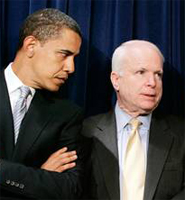
Obama’s election did show that millions of whites could strap racial blinders around their eyes and punch the ticket for an African-American for the world’s most powerful political post. King would almost certainly glow with approval at that. But there are a couple of troubling caveats that mar America’s great racial leap forward. Obama won in large part because he did what no other Democratic presidential candidate did, and that includes Bill Clinton. He turned his presidential campaign into a virtual holy crusade by African-Americans voters to get him in the White House. The staggering 96 percent of the black vote he got made the crucial difference in the key Democratic primaries and later in nailing down the victory over Republican rival John McCain in the must win states of Ohio and Pennsylvania.
At the same time, Obama’s allure to white college educated young, business and professionals was overstated. McCain got 53 percent of their vote. He trounced Obama among North and South rural, and blue collar whites. Obama won in only 44 counties in the Appalachian belt, a stretch of more than 400 counties from New York to Mississippi. Overall, he got less than a third of Southern white votes. The racial fault lines are still tightly drawn within a wide segment of the electorate.

A mid-September 2008 survey also found that a significant percentage of whites who said they’d vote for Obama also said that blacks were more crime prone and less industrious than whites. There were several ways to look at this seeming racial paradox. One is that these Obama backers were so fed up with Bush policies and a battered economy that Obama offered a change and a lifeline. Another was that he presented a race neutral soothing departure from the perceived race baiting antics of Jesse Jackson and Al Sharpton. And yet another was that he simply was sufficiently racially ambiguous enough not to pose any real racial threat.
In other words, he was seen as a racial exception. That's the penchant for some whites to make artificial distinctions between supposedly good and bad blacks.
These explanations don’t point to a profound and benign sea change in racial attitudes let alone tell why negative racial notions could still be rife among many white Obama supporters. The reports that Obama has received more taunts and physical threats than any other president-elect is another troubling indication that an untold number of Americans still can’t stomach the thought of an African-American in the White House.

The hoisting of Obama to a rarified political or non racial pedestal is the exact opposite of what King had in mind. In that same March on Washington speech what’s forgotten or deliberately distorted is that King talked much about the legacy of segregation, bigotry and discrimination that trapped thousands of poor blacks and that offered no easy resolution. Nearly a half century after King’s I Have a Dream words the black poor are still just as tightly trapped in the grip of poverty and discrimination that King warned about.

On the eve of the King national holiday and Obama’s inauguration, the Boston based research and economic justice advocacy group, United for a Fair Economy, released its sixth annual King Day report. It found that the gaping disparities in income, wealth, employment, quality and availability of housing, decent schools, and health care between blacks, minorities and whites has grown even wider. Countless government reports and studies, and the National Urban League’s 2007 State of Black America report also found that discrimination and poverty are still major barriers for millions. And it’s not just the black poor that bear the brunt of discrimination. President Bush even wondered out loud recently why there were so few black reporters covering his press conferences.
Obama has publicly bristled at the notion that the civil rights movement is outdated, or worse that he somehow supplants the ongoing work of civil rights leaders. He has repeatedly praised past civil rights leaders for their heroic battle against racial injustice.
It was not simply showy campaign symbolism when Obama pegged his Democratic presidential nomination acceptance speech to the 45th anniversary of the March on Washington last August. This was a fitting tribute to the civil rights movement that challenged the nation to make King's dream of justice and equality a reality. Obama faced that challenge as a community organizer, civil rights attorney, during his stints in the Illinois legislature and in the Senate. He faces that same challenge in the White House. There’s still much to overcome.

Earl Ofari Hutchinson is an author and political analyst. His new book is How Obama Won (Middle Passage Press, January 2009).

Thursday, October 30, 2008

Why Race Won’t Hurt Obama on November 4th


Earl Ofari Hutchinson

Republican presidential contender John McCain got one thing right about Democratic rival Barack Obama. He told Larry King that he didn’t think race would be much of an issue in the final vote. As McCain put it only “a tiny, tiny, minority” will vote against Obama because he’s black. McCain was not just campaign bloviating to puff up his oft touted credential as a play it straight on race guy. The notion that because millions of whites passionately back Obama race is permanently off America’s table is more hope and prayer than reality.

Still despite endless and obsessive speculation that race could derail Obama in his slog to the White House it won’t and it probably never would have. Start with McCain and Obama; McCain made the personal and pragmatic choice not to make race an issue either directly or indirectly through code words, snide hints, and racial guilt by association attacks. When the Jeremiah Wright flap cropped up, he could have hammered Obama as a stealth race baiter. He turned thumbs down on that. Later when VP mate Sarah Palin and some others in his campaign were etching to unload on Obama-Wright again, he still said no.

That decision was not totally due to honor and noble intent. A too frontal racial attack would have brought instant screams of foul from Democrats, and millions of voters who demanded that the campaign be a clean, issues focused campaign. McCain read the political leaves correctly and saw the political peril in flipping the race card. The occasions that he slipped and rapped Obama as a socialist and a terrorist fellow traveler brought universal condemnation that he was going negative or worse running a dirty campaign.
Obama helped things even more. The firm message in his signature slogan of hope and change, campaign literature, TV ads, rallies, in pitches to contributors, his core of advisors, and major endorsers was that the Obama presidential campaign and an Obama presidency would be broad, non-racial and issues driven. Anything else would have instantly stirred horrifying visions to many of Al Sharpton and Jesse Jackson. His candidacy would have been DOA.

But McCain and Obama’s best efforts to make race a non issue in the campaign would have fallen short without the sea change shift in public attitudes. The decade since the Rodney King beating, the O.J. Simpson trial, and the urban riots, has been a period of relative racial peace in America. During that time polls consistently showed that more whites than ever are genuinely convinced that America is a color-blind society, equal opportunity is a reality, and blacks and whites if not exactly attaining complete social and economic equality, are closer than ever to that goal. Though the figures on income, education and health care still show a colossal gap between poor blacks and whites, the perception nonetheless is that racism is an ugly and nasty byproduct of a long by-gone past.

The passage by huge margins of anti-affirmative action measures in California, Michigan, and Washington, was not simply a case of whites engaging in racial denial or a cover for hidden bias. Many white voters backed the initiatives because they honestly believed that color should never be in the equation in hiring and education, and that race is divisive.
It’s is easy to see why they believe that. "Whites only" signs and redneck Southern cops unleashing police dogs, turning fire hoses on and beating hapless black demonstrators have long been forgotten. Americans turn on their TVs and see legions of black newscasters and talk show hosts, topped by TV's richest and most popular celebrity, Oprah Winfrey.

They see mega-rich black entertainers and athletes pampered and fawned over by a doting media and an adoring public. They see TV commercials that picture blacks living in trendy integrated suburban homes, sending their kids to integrated schools and driving expensive cars. They see blacks such as former Secretary of State Colin Powell and his successor Condoleezza Rice in high-profile policy-making positions in the Bush administration. They see dozens of blacks in Congress, many more in state legislatures and city halls. They see blacks heading corporations and universities. And those blacks who incessantly scream racism about their plight are roundly reviled for feeding racial paranoia.
There is even some talk that the so-called Bradley Effect, the penchant for whites to lie to pollsters about their true racial feelings and vote against a black candidate, may actually turn into a reverse Bradley Effect this election. That’s that many whites will vote for Obama because he’s black. That notion is just as dubious as the Bradley Effect. But to even raise the possibility tells much about changing times and attitudes.

If Obama wins and that seems likely, race will be, as McCain says, only a tiny, tiny factor. That’s a tribute to him, Obama and the millions of America voters that were determined to make sure that race did not hurt Obama on November 4th

Earl Ofari Hutchinson is an author and political analyst. His latest book is The Ethnic Presidency: How Race Decides the Race to the White House (Middle Passage Press, February 2008).

Wednesday, October 22, 2008

Why Some Racists like Obama


Earl Ofari Hutchinson


Not long after Democratic presidential contender Barack Obama tossed his hat in the presidential rink back in February 2007, an odd, even bizarre thing happened. A hodgepodge of avowedly racist groups burned up internet sites not with rage, but glee. They were giddy at the thought that Obama might win.

Their rationale was that an African-American in the White House would prove their point that blacks were out to dominate whites and that whites would be so disgusted that they would unite in righteous and very racist anger. That in turn would trigger their long swooned over racist fantasy of a race war. This was dismissed for what it was, namely the ranting of the racist lunatic fringe. But that doesn’t mean that many whites who harbor hidden or even conscious racial animus won’t also back Obama albeit for their own reasons. A mid-September survey found about one quarter of whites hold negative views of blacks that are top heavy with the old shop worn stereotypes. The respondents said that blacks use race as a crutch, are not as industrious as whites, oppose interracial marriage, and are terrified of black crime (Obama mildly chided his white grandmother in his so-called race speech back in March for saying she feared black men). Yet nearly a quarter of them claim they’ll vote for Obama.

The standard explanation for this seeming racial schizoid view is that whites are so hammered by financial hardship that the economy trumps race and that Obama can do more to help them out of their financial hole than Republican rival John McCain. Others like him because his race neutral campaign is a soothing departure from the perceived race baiting antics of Jesse Jackson and Al Sharpton. Still others like him because his racially exotic background supposedly doesn’t fit that of the typical African American.

There is truth in these reasons cited to explain Obama’s appeal to some racial bigots. But there’s another reason that hasn’t been cited. That’s the long, checkered, and tortured history of racial exceptionalism. That’s the penchant for some whites to make artificial distinctions between supposedly good and bad blacks. That’s apparent in the unthinking offensive, insulting, and just plain dumb crack made to some articulate, well-educated blacks in business and the professions that they are “different than other blacks or not like other blacks.”

Racial exceptionalism also stems from the ingrained, but terribly misplaced, belief that blacks are perennially disgruntled, hostile, and rebellious, and are always on the lookout for any real or perceived racial slight, and etch to pick a fight over it.

An African-American who doesn’t fit that type is touted, praised, even anointed by some as the reasoned voice of black America. A century ago the mantle of the reasoned, exceptional African-American was bestowed on famed educator, Booker T. Washington. He was showered with foundation and corporate largesse. In the 1920s and 30s, NAACP leaders always found a ready welcome at the White House. They were praised in the press and bankrolled by some industrialists. In the 1960s Urban League President Whitney Young, NAACP executive secretary Roy Wilkins, and Martin Luther King Jr. before he fell out of favor with the Lyndon Johnson White House after his too vocal opposition to the Vietnam War and turn to economic radicalism, were lionized for their reason and racial moderation.

In the 1980s, Presidents Reagan and Bush Sr. actively cultivated and promoted a bevy of younger GOP friendly academics, black business leaders, and black conservatives. Reagan and Bush Sr. plainly saw them as a leadership alternative to the black Democrats and the old guard civil rights leaders. The black conservatives were appointed to government posts, bagged foundation grants, were feted by conservative think tanks, and their columns were routinely published in major newspapers. They were continually cited by writers and reporters as a breath of fresh air among African-Americans mostly for their willingness to break ranks with and to blister Jackson, Sharpton, and the civil rights establishment.

Obama hardly fits the mold of a black conservative, but neither is he the ultra-liberal Democrat that some conservative opponents routinely paint him as. Even before his rocket launch to the threshold of the presidency, he was considered a moderate, centrist Democrat, a consummate party insider, and a rising Beltway establishment politician. Without that stamp of mainstream approval, his White House bid would have never got to political first base.

Obama bristles publicly at the notion that he’s in competition with or a critic of civil rights leaders, or that he is immune from racial jabs. He has repeatedly praised past civil rights leaders for their heroic battle against racial injustice. That’s good, but that doesn’t erase the nagging penchant to elevate some blacks above the racial fray, and declare them the exception. That includes some white bigots who say they’ll back Obama.

Earl Ofari Hutchinson is an author and political analyst. His new book is The Ethnic Presidency: How Race Decides the Race to the White House (Middle Passage Press, February 2008).